
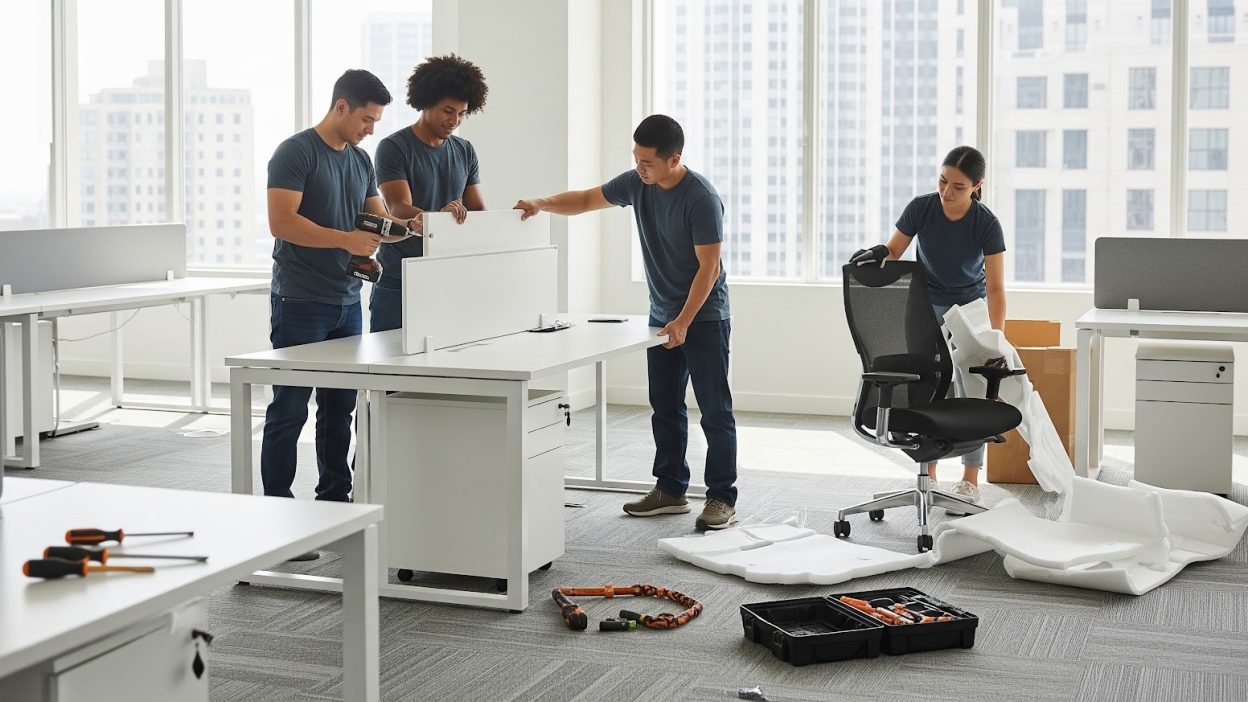
Choosing between an open office vs. cubicle layout in Houston, TX is one of the most consequential decisions a facilities manager or business owner can make before investing in new workplace furniture. The layout you choose shapes how employees communicate, concentrate, and collaborate every single day. Professional office furniture installation is a major investment, and making an informed decision upfront can save thousands of dollars and prevent costly do-overs.
This guide breaks down the key differences between open-plan and cubicle environments across four critical dimensions: noise and collaboration, privacy, cost, and hybrid planning. Whether you manage a startup, a law firm, or a mid-sized corporation, the information here will help you match your workspace design to your team’s actual working style.
Understanding the Two Core Office Layouts
Before diving into comparisons, it helps to define what each layout actually looks like in practice.
An open office removes most or all physical barriers between workstations. Employees sit at rows of desks or shared benching systems in a single large space. The idea is to encourage spontaneous interaction, speed up communication, and project a modern, transparent culture.
A cubicle layout uses partial-height or full-height panels to create individual workstations separated from one another. Each employee has a defined personal space with varying degrees of visual and acoustic privacy depending on panel height and configuration.
Both approaches have evolved significantly over the past two decades, and neither is universally superior. The right fit depends on the nature of the work being done, the size of the team, and the overall business culture.
Noise, Collaboration, and Privacy: A Side-by-Side Comparison
Noise Levels
Noise is the single most common complaint in open offices. Research from Oxford Economics found that the inability to concentrate due to noise is one of the top factors reducing productivity among office workers. In an open floor plan, conversations, phone calls, keyboard sounds, and ambient movement blend into a constant hum that many employees find distracting.
Cubicles reduce noise transmission considerably, especially when panels reach 60 inches or higher. Workers in cubicle environments report significantly fewer interruptions during focused tasks. However, cubicles do not provide soundproofing, and a noisy neighbor can still disrupt concentration in lower-panel configurations.
Collaboration
Open offices genuinely win in this category. When no physical barriers exist between team members, casual conversations happen naturally. Quick questions get answered without scheduling a meeting. Creative teams, sales floors, and agile development teams often thrive in open environments because speed of communication directly affects their output.
Cubicles, by contrast, can reduce spontaneous collaboration. Workers tend to stay within their individual spaces longer, and cross-team communication may require more deliberate effort. That said, some industries actively benefit from this reduced interruption culture, particularly roles that require deep, sustained concentration such as accounting, legal research, data analysis, or technical writing.
Privacy
Privacy in the workplace has two dimensions: visual and acoustic. Open offices score poorly on both. Employees can see each other’s screens, observe personal habits, and overhear sensitive conversations. For organizations handling confidential client information, healthcare data, or financial records, this can present real compliance risks.
Cubicles restore a meaningful level of privacy. Higher panel systems can shield screens entirely and significantly reduce the chance of overhearing private conversations. Employees also report feeling more psychologically comfortable in defined personal spaces, which can reduce stress and improve focus according to studies published by the American Psychological Association.
Cost Breakdown: What to Expect for Each Layout
Cost is rarely simple in commercial office design. Both upfront expenses and long-term operational costs vary considerably depending on layout choices.
Open Office Costs
Open office furniture tends to cost less per workstation than full cubicle systems. Basic benching desks can run between $300 and $800 per seat, and the lack of panels reduces materials and installation labor. However, open offices often require significant investment in acoustic mitigation after the fact. Sound-absorbing ceiling tiles, acoustic panels, privacy pods, and white noise systems can add $500 to $2,000 per employee or more.
Installation is generally faster and simpler for open layouts since there are fewer components to assemble and align. Reconfiguring the space when team sizes change is also more straightforward and less expensive.
Cubicle Layout Costs
A mid-range cubicle system typically costs between $1,500 and $4,000 per workstation when factoring in panels, work surfaces, overhead storage, and labor. High-end systems from manufacturers like Herman Miller or Steelcase can exceed $6,000 per station. Installation requires more skilled labor and more time, which increases the upfront investment further.
However, cubicles can reduce long-term costs in meaningful ways. Employees working in private, distraction-free environments tend to be more productive, which has a direct impact on output per hour. Turnover rates linked to workplace dissatisfaction also tend to be lower in environments where workers have personal space, reducing recruiting and training costs over time.
Maintenance costs for cubicle systems are worth factoring in as well. Panel fabric wears and stains, connectors loosen over years of use, and older systems may require replacement parts that are no longer in production. Open office furniture is generally simpler and less expensive to maintain.
Hybrid Layouts: Getting the Best of Both Worlds
Many organizations find that neither a fully open nor a fully cubicle-based environment serves all of their needs. A hybrid layout strategically combines elements of both to match different work modes throughout the day.
When a Hybrid Approach Makes Sense
A hybrid layout works well when a team has multiple distinct work modes. For example, a marketing department may need open collaborative zones for brainstorming and campaign reviews, while also needing quiet areas for writing, editing, or analytical work. A customer support team may require semi-private cubicle-style workstations for focused call handling but benefit from shared open spaces for team meetings and training.
Hybrid layouts also accommodate changing headcounts more gracefully. As teams grow or shrink, modular cubicle pods can be added or removed, and open benching areas can absorb fluctuating numbers without requiring a full redesign.
Planning the Transition
Transitioning to a hybrid layout requires a clear assessment of how different roles actually spend their time. Employee surveys and conversations with team leads can reveal whether most of the team spends the majority of their day in focused solo work or in collaborative group activity. This data should drive the ratio of open to enclosed space in the final design.
Acoustic zoning is critical in hybrid spaces. Collaborative zones should be positioned away from quiet focus areas, ideally with buffer zones like storage walls, planters, or acoustic partitions in between.
Working with an experienced office furniture installation team during the planning phase can prevent costly layout errors before a single panel is assembled. Professional installers understand weight distribution, power and data access requirements, ADA compliance considerations, and building code factors that can affect the final result.
Key Factors to Evaluate Before Making a Decision
Several practical questions can simplify the decision. Consider whether your team’s work requires sustained concentration or frequent communication. Evaluate current noise complaints and review your budget with attention to both upfront and long-term costs. Think about whether your space needs to flex over the next few years as your team grows. The goal is to identify which tradeoffs align with your team’s actual working style.
Final Thoughts on Choosing Your Office Layout
Choosing between an open office and a cubicle layout is not simply an aesthetic decision. It affects employee wellbeing, productivity, retention, and operational costs in measurable ways. Open offices offer lower upfront costs and a naturally collaborative environment, but they come with real noise and privacy challenges. Cubicles provide structure and focus but require a larger initial investment and more deliberate planning to prevent isolation.
For many organizations, a thoughtfully designed hybrid layout offers the most practical path forward. By understanding how your team actually works and planning around those behaviors, you can invest in a workspace that supports performance. You can also explore local installation services to find qualified professionals in your area who can help bring your layout plan to life.
The furniture decisions you make today will shape how your team operates for years to come. Comparing options carefully, consulting with installation experts, and involving employees in the planning process will make the outcome far more successful than simply following a trend.
Frequently Asked Questions
1. What is the main difference between an open office and a cubicle layout?
An open office removes physical barriers between workstations to promote collaboration and communication. A cubicle layout uses panels to create individual, semi-enclosed workspaces that offer more privacy and reduced noise exposure. The right choice depends on the type of work being performed and the needs of the team.
2. Which office layout is better for employee productivity?
It depends on the role. Research suggests that employees performing focused, independent work such as writing, analysis, or data processing are more productive in cubicle environments due to lower distraction levels. Employees in collaborative or creative roles often benefit from the open communication that open office layouts enable.
3. How much does it cost to install a cubicle system compared to an open office layout?
Cubicle systems typically cost between $1,500 and $4,000 per workstation including labor, while open office benching systems can run $300 to $800 per seat. However, open offices often require additional investment in acoustic solutions that can significantly close the cost gap over time.
4. What is a hybrid office layout and when should a company use one?
A hybrid office layout combines open collaborative zones with private or semi-private work areas within the same floor plan. It is most effective for teams that have mixed work modes, meaning some employees need frequent interaction while others need extended quiet time for focused tasks.
5. Can cubicles be reconfigured if my team grows or changes?
Yes. Most modern cubicle systems are designed to be modular, meaning panels and work surfaces can be rearranged, added, or removed. However, reconfiguration requires skilled labor and may involve procurement of additional components. Open office furniture is generally easier and less expensive to reconfigure as team sizes fluctuate.
6. How do I reduce noise in an open office without installing cubicles?
Several strategies can reduce noise in open office environments without adding panel systems. These include installing sound-absorbing ceiling tiles and wall panels, using white noise or sound masking systems, adding rugs and soft furniture to absorb sound, and creating designated quiet zones within the open space. For more guidance, resources from organizations like WELL Building Standard provide evidence-based recommendations for acoustic comfort in workplaces.