Watches are precision instruments that require periodic care to keep running accurately and reliably. Whether you own a classic mechanical heirloom or an everyday quartz timepiece, recognizing the signs watch needs servicing in Greenville, SC early can be the difference between a simple tune-up and a costly full repair. Ignoring minor symptoms often allows small mechanical issues to escalate into serious movement damage that requires expensive parts replacement. If your timepiece has been showing any unusual behavior, consulting a qualified watch repair and maintenance service should be your first step.
Understanding what to look for gives every watch owner a significant advantage. Below are five of the most important warning signs that your watch is overdue for professional attention.
1. Condensation or Moisture Under the Crystal
One of the most urgent signs that your watch requires immediate professional attention is the presence of fog, moisture droplets, or condensation visible beneath the crystal. This is not a cosmetic issue. Water intrusion is a direct threat to the movement inside.
Modern watches are engineered with gaskets and seals that create a barrier against moisture. Over time, these seals degrade due to age, heat exposure, UV radiation, and general wear. Once a seal fails, even minor humidity can make its way into the case. Inside the watch, moisture accelerates oxidation of metal components, promotes corrosion on delicate gear trains, and can leave behind mineral deposits that interfere with the movement’s lubrication.
According to Watchtime, the movement of a fine mechanical watch contains hundreds of individual parts, many of which are toleranced to within microns. Corrosion in this environment does not just slow a watch down; it can permanently destroy irreplaceable components.
If you notice any cloudiness under the glass, remove the watch from your wrist and avoid exposing it to further moisture until it has been inspected. A watchmaker can replace the seals, dry out the case, and assess whether any internal components have already been compromised.
2. Losing or Gaining More Than a Few Seconds Per Day
All watches drift slightly over time, but there is an acceptable range for each type. Knowing these tolerances helps you identify when something is genuinely wrong.
Quartz watches are regulated by a battery-powered oscillating crystal that vibrates at a consistent frequency. A well-functioning quartz watch should be accurate to within plus or minus 15 seconds per month, which works out to roughly half a second per day. If your quartz watch is gaining or losing several minutes each week, the issue may go beyond a dying battery.
Automatic and mechanical watches operate on a different standard. These movements are driven by a mainspring wound either manually or by the motion of the wearer’s wrist. The COSC chronometer certification standard requires a movement to maintain accuracy within minus 4 to plus 6 seconds per day. For non-certified automatics, a daily variance of plus or minus 10 to 15 seconds is generally considered acceptable. Anything beyond that warrants a closer look.
Accuracy issues in mechanical watches are often caused by worn or magnetized components, dried-out lubricants, or damaged regulating parts. In quartz watches, the oscillator itself can fail or the circuit board can degrade. Either way, a professional timing diagnosis will pinpoint the cause quickly.
3. A Sluggish, Stuttering, or Erratic Second Hand
The behavior of the second hand is one of the clearest windows into the health of your watch movement. Any deviation from smooth, consistent motion is worth taking seriously.
On a quartz watch, the second hand should advance in clean, even one-second ticks. If the hand starts skipping multiple seconds at a time, stuttering in place, or moving erratically, this is a classic sign of a dying battery. However, if a new battery does not resolve the problem, the movement itself may have an internal fault.
On an automatic or mechanical watch, the second hand should sweep smoothly across the dial in a continuous gliding motion. A sluggish sweep that seems to drag, hesitate, or stop intermittently often points to dried lubricants inside the movement. Watch oils break down over time and can thicken into a sticky residue that impedes the gear train. This is one of the primary reasons manufacturers recommend periodic servicing regardless of whether a watch seems to be working properly.
As explained by Hodinkee, even watches that appear to be running normally benefit from professional cleaning and relubrication at regular intervals, typically every five to seven years for mechanical movements.
4. A Battery That Drains Unusually Quickly
For quartz watch owners, battery life is a reliable diagnostic indicator. Most quality quartz movements are designed to run for one to three years on a single battery, and some high-efficiency movements last even longer. If you find yourself replacing the battery far more frequently than expected, this is a sign watch needs servicing beyond just a battery swap.
Excessive battery drain can be caused by several factors. A short circuit within the movement draws power continuously. Damaged or corroded contacts force the circuit to work harder than intended. In some cases, moisture intrusion creates conductivity problems that accelerate energy consumption.
There is also an important consideration around when a battery replacement alone is sufficient versus when a full movement cleaning is needed. If the watch is relatively new, has been well-maintained, and shows no other symptoms, a fresh battery may be all that is required. However, if the watch is several years old, has never been serviced, or displays other warning signs alongside the short battery life, a watchmaker should inspect the full movement. Servicing at this stage can prevent a minor electrical issue from evolving into complete movement failure.
5. Physical Damage to the Crown, Crystal, or Case
The external condition of a watch does more than affect its appearance. Physical damage to the case or components can directly compromise the integrity of the movement inside.
A cracked or scratched crystal may seem like a cosmetic problem, but even a hairline crack can allow dust and moisture to enter the case. The crystal forms part of the environmental seal on many watches, and any breach in that seal undermines the protection of the movement.
The crown, which is the small winding and setting knob on the side of the case, is another common point of vulnerability. A loose, wobbly, or difficult-to-operate crown may indicate that the internal threading is worn or that the crown seal has failed. Because the crown is one of the primary entry points for water and debris, even minor damage here should be addressed promptly.
Dents, dings, or warping along the case back can also compromise the seal between the case and its back cover. If the case back does not seat properly, water resistance is reduced even if the gaskets themselves are intact.
A watchmaker can replace crystals, recondition crowns, and restore case back seals as part of a routine service, making these repairs far more affordable when caught early.
How Often Should a Watch Be Serviced?
Even in the absence of obvious warning signs, watches benefit from proactive maintenance. Most Swiss manufacturers recommend servicing mechanical and automatic watches every three to five years. Quartz watches generally require less frequent attention but should be inspected every five to seven years.
Skipping scheduled servicing does not just affect accuracy. Dried lubricants create friction that causes accelerated wear on gears, jewels, and other precision components. Parts that could have been cleaned and relubricated often need to be replaced entirely once wear reaches a certain threshold. According to WatchUSeek, preventive maintenance consistently costs far less than reactive repairs.
Wrapping Up: Small Signs, Big Consequences
The five warning signs covered here, namely condensation under the crystal, inaccurate timekeeping, a sluggish second hand, short battery life, and physical case damage, are all early indicators that your timepiece needs professional attention. Each of these issues is manageable and relatively affordable when addressed at the first sign of trouble. Waiting, however, allows small problems to compound into significant movement damage that may require expensive parts, extensive labor, or in some cases, cannot be fully reversed.
Treating your watch as the precision instrument it is means responding to warning signs promptly rather than waiting for the watch to stop entirely. A skilled watchmaker can diagnose problems accurately, perform necessary cleaning and lubrication, replace worn components, and restore your watch to proper working condition.
For residents in the area looking for trusted local expertise, this watch repair location provides professional servicing for a wide range of timepieces.
Frequently Asked Questions
Q1: How do I know if my watch needs a service or just a new battery?
If your quartz watch has stopped or is running slow, start with a battery replacement. If the problem persists after a new battery is installed, or if the new battery drains unusually fast, the movement likely needs a professional inspection. Mechanical watches do not use batteries and should be serviced based on performance and age.
Q2: Can moisture damage a watch permanently?
Yes. If moisture reaches the movement, it can cause corrosion and oxidation on metal components that cannot always be reversed. Prompt professional drying and inspection after moisture intrusion gives the best chance of preventing lasting damage.
Q3: Is it safe to keep wearing a watch that is losing a few seconds per day?
Minor timekeeping variance is normal, especially in mechanical watches. However, if the drift exceeds the acceptable range for your watch type or is getting progressively worse, it is worth having a watchmaker inspect the movement before the issue becomes more serious.
Q4: How long does a professional watch service typically take?
A standard service for a mechanical or automatic watch generally takes between one and four weeks depending on the watchmaker, the complexity of the movement, and whether any parts need to be ordered. Simple quartz services or battery replacements are often completed much more quickly.
Q5: What happens during a professional watch service?
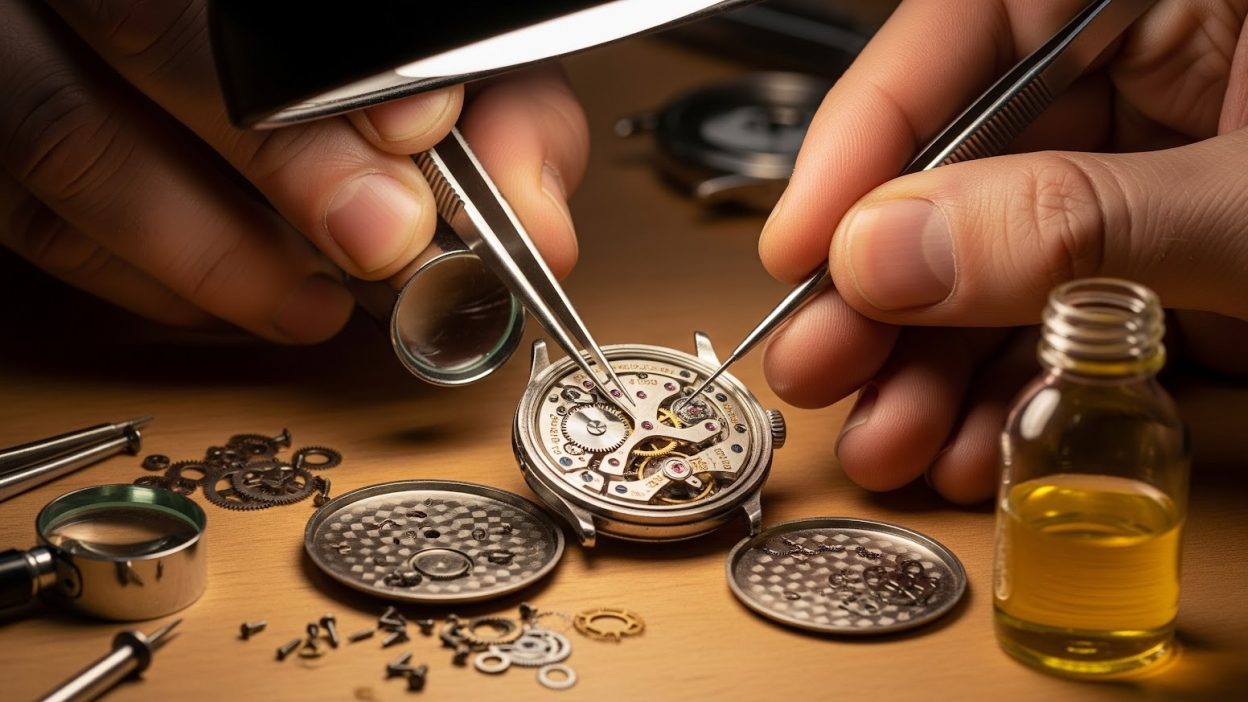
A full service typically involves disassembling the movement, cleaning all components in an ultrasonic bath, inspecting each part for wear or damage, replacing worn components, relubrication with appropriate watch oils, reassembly, timing adjustments, and a pressure test to verify water resistance. The case and bracelet are also usually cleaned and polished as part of the process.