
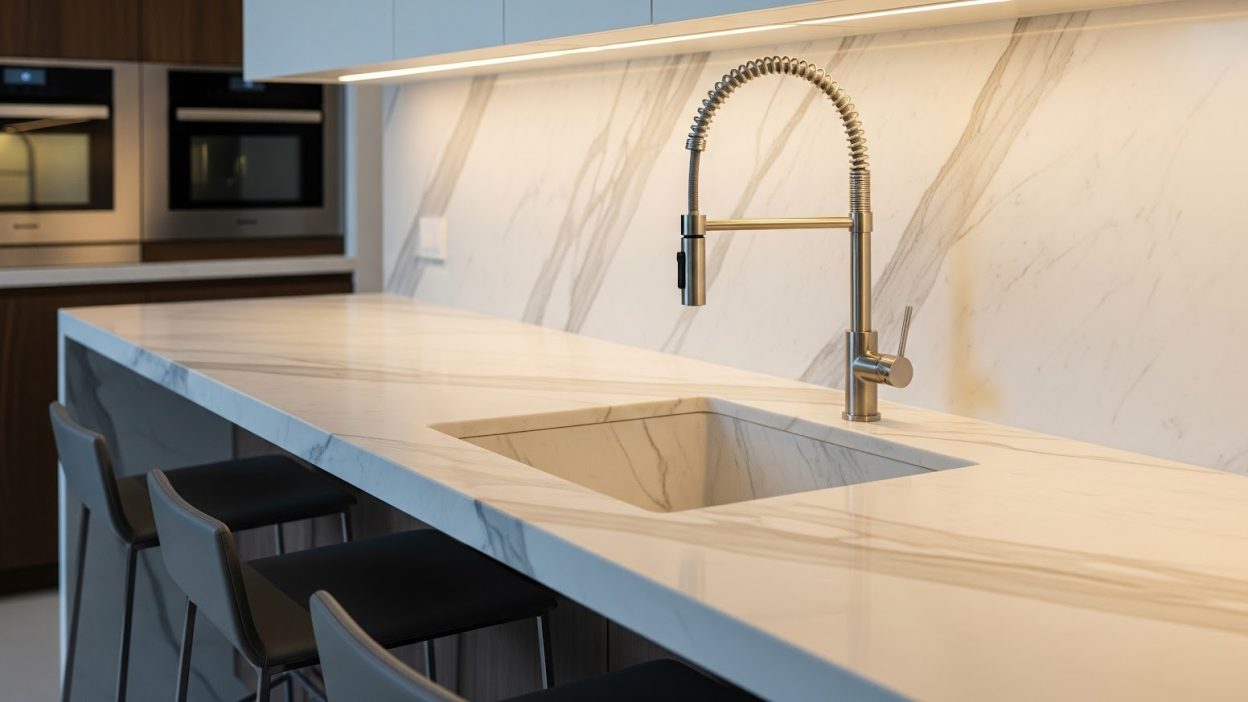
When planning a kitchen remodeling project, few decisions carry more visual and financial weight than your countertop material. For homeowners exploring quartz vs. granite kitchen remodel in Cincinnati, the options can feel overwhelming, especially when showroom salespeople have a financial stake in what you choose. This guide cuts through the noise with an honest, side-by-side breakdown of both materials so you can make the choice that truly fits your home, your lifestyle, and your budget.
Understanding the Basics: What Are Quartz and Granite?
Before comparing them head to head, it helps to understand what each material actually is.
Granite is a natural stone quarried directly from the earth. Each slab is genuinely one of a kind, shaped by millions of years of geological activity. It is composed primarily of quartz, feldspar, and mica, which gives it its characteristic speckled or veined appearance.
Quartz countertops, by contrast, are engineered stone products. They are made from roughly 90 to 95 percent ground natural quartz crystals combined with resins, polymers, and pigments. Brands like Caesarstone, Silestone, and Cambria are among the most recognized names in this category. Because they are manufactured, quartz countertops offer a much more consistent appearance and a wider range of color options than natural stone.
Head-to-Head Comparison: Durability, Heat, Stains, and Maintenance
Durability
Both materials are exceptionally hard and resistant to everyday wear. On the Mohs hardness scale, granite typically scores between 6 and 7, while quartz engineered stone generally lands around 7. In practical terms, both surfaces will hold up well against scratching from pots, pans, and utensils.
However, granite is a natural material with variations in density, meaning some slabs can have micro-fissures or softer mineral pockets that make them slightly more prone to chipping at corners and edges. Quartz, because it is manufactured under controlled conditions, tends to be more uniform and therefore slightly more chip-resistant across the board.
Verdict: Quartz has a slight edge for overall consistency and chip resistance.
Heat Resistance
This is one area where granite has a meaningful advantage. Because it is a natural stone formed under extreme heat, granite can handle hot pots and pans placed directly on the surface without damage. While it is still best practice to use trivets to protect any countertop, granite is forgiving in the heat department.
Quartz, on the other hand, contains polymer resins that can be damaged by sustained high heat. Temperatures above 300 degrees Fahrenheit can cause discoloration, cracking, or warping. If you regularly pull heavy roasting pans or cast iron skillets straight from the oven to the counter, granite is the safer choice.
Verdict: Granite wins on heat resistance. According to Consumer Reports, quartz countertops can scorch or discolor under direct high heat.
Stain Resistance
Here, quartz takes a decisive lead. Because it is non-porous by nature of its manufactured composition, quartz does not absorb liquids. Coffee, wine, tomato sauce, and cooking oils wipe away cleanly without penetrating the surface.
Granite, being a natural stone, is porous. Without proper sealing, it can absorb liquids and develop stains over time. A freshly sealed granite countertop performs very well, but that protection does not last forever. Most experts recommend resealing granite every one to two years depending on use, though some denser varieties may only need sealing every three to five years. The National Granite and Stone Association provides guidelines on proper stone care and sealing schedules.
Verdict: Quartz wins decisively on stain resistance.
Long-Term Maintenance
Quartz requires virtually no ongoing maintenance beyond routine cleaning with mild soap and water. There is no sealing, no special stone cleaners required, and no worry about reapplication schedules.
Granite demands more attention. In addition to periodic sealing, you should avoid harsh chemical cleaners that can strip the sealant. Vinegar, bleach, and citrus-based cleaners should all be kept away from granite surfaces. For busy households, this added maintenance layer is a real consideration.
Verdict: Quartz is clearly lower maintenance over the long term.
Installed Cost Ranges in the Cincinnati Market
Cost is often the deciding factor for homeowners, and both materials span a wide price range depending on the grade, edge profile, and complexity of the installation.
In the Cincinnati area, granite countertops are typically installed at costs ranging from $45 to $100 per square foot, including materials and labor. Entry-level granite from common quarrying regions tends to be on the lower end of that range, while exotic slabs with unusual coloring or dramatic veining can push well above $100 per square foot.
Quartz countertops in Cincinnati generally run from $55 to $120 per square foot installed. The engineered manufacturing process, combined with brand licensing fees, tends to push the baseline cost slightly higher than commodity granite. Premium designer quartz lines, particularly those mimicking the look of marble, can reach $150 per square foot or more.
When factoring in long-term costs, quartz’s lower maintenance requirements can offset the higher upfront price over a 10 to 15 year horizon. Sealing granite two to three times over a decade, combined with any potential stain remediation, adds real costs that do not apply to quartz.
Impact on Kitchen Remodel ROI at Resale
According to Remodeling Magazine’s Cost vs. Value Report, a major kitchen remodel in the Midwest recoups approximately 54 to 60 percent of its cost at resale. Countertop material plays a role in that figure, but it is rarely the primary driver of buyer decision-making.
That said, both granite and quartz are considered premium materials that appeal to buyers in Cincinnati’s market. Quartz’s low-maintenance reputation resonates strongly with buyers who prioritize ease of upkeep. Granite’s natural beauty and uniqueness can be a selling point for buyers who value authenticity and character. Neither material gives you a significant resale edge over the other when both are installed at a comparable quality level.
Choosing Based on Your Household Lifestyle
The best countertop for your kitchen is ultimately the one that fits how you actually live, not the one a showroom rep is most motivated to sell.
Families with Young Children
If your kitchen sees spilled juice, arts and crafts projects, and constant activity from little hands, quartz is the practical choice. Its non-porous surface resists staining from common household messes, and you will not spend weekends re-sealing stone to maintain its appearance. The durability and easy cleanup make it a natural fit for high-traffic family kitchens.
Avid Home Cooks
Home cooks who spend serious time in the kitchen face a real tradeoff. Quartz offers stain resistance that matters when working with beets, turmeric, or red wine reductions. However, the heat sensitivity is a genuine concern. If your cooking style involves frequently moving heavy, hot cookware from the range to the counter, granite is worth serious consideration. Pairing granite with consistent use of trivets can give you the best of both worlds.
Frequent Entertainers
For homeowners who host regularly and want a kitchen that impresses guests, both materials deliver. Granite’s natural variation creates a visual complexity that is hard to replicate, while premium quartz lines offer dramatic veining patterns that rival the look of luxury marble at a lower price point. For entertainers, the decision often comes down to aesthetics as much as function. Visiting a stone yard to view full slabs in person, rather than relying on small samples, is strongly recommended before making a final choice.
Final Thoughts: Making the Right Call for Your Kitchen
Both granite and quartz are excellent countertop materials, and the best choice depends on your priorities as a homeowner. If low maintenance, stain resistance, and consistency are at the top of your list, quartz is likely the smarter investment. If you love the idea of owning a truly unique, natural material and are comfortable with periodic upkeep, granite delivers a warmth and character that engineered stone struggles to fully replicate.
Before you commit to either material, spend time with full-sized slabs, not just samples. Bring paint swatches and cabinet door samples with you to the stone yard. And take the time to understand what each material requires from you as an owner over the years ahead.
For homeowners in the greater Cincinnati area looking for expert guidance, you can also find a local kitchen remodeling professional on Google Maps to schedule a consultation and view material options in person.
Wrapping It All Up: The Bottom Line on Quartz vs. Granite
There is no universal winner in the quartz vs. granite debate. What matters most is matching the material to your actual lifestyle, maintenance tolerance, and design preferences. Quartz wins on practicality, ease of care, and stain resistance. Granite wins on heat tolerance, natural beauty, and the satisfaction of owning something genuinely unique. In the Cincinnati market, both materials are competitively priced, and both deliver strong visual appeal that holds up at resale. The best approach is to go in informed, ask the right questions, and trust your own priorities over a salesperson’s commission.
Frequently Asked Questions
1. Is quartz or granite better for a busy family kitchen?
Quartz is generally the better choice for busy family kitchens. Its non-porous surface resists staining from everyday spills, and it requires no periodic sealing. Families with young children especially benefit from quartz’s forgiving, easy-clean properties.
2. Can I place hot pans directly on quartz countertops?
It is not recommended. Quartz contains resins that can discolor or crack when exposed to sustained high heat above approximately 300 degrees Fahrenheit. Always use trivets or hot pads when placing hot cookware on quartz surfaces.
3. How often does granite need to be sealed?
Most granite countertops should be resealed every one to two years, depending on the density of the stone and how heavily the kitchen is used. Some high-density granite varieties may only require sealing every three to five years. You can test your granite by placing a few drops of water on the surface; if it absorbs rather than beads, it is time to reseal.
4. Does granite or quartz add more value to a home in Cincinnati?
Both materials are considered premium upgrades in the Cincinnati market and are viewed favorably by buyers. Neither material holds a clear resale advantage over the other when installed at a comparable quality level. The more important factor is the overall quality and cohesiveness of the kitchen remodel.
5. Which countertop material is easier to repair if it chips or cracks?
Granite chips and cracks can often be repaired by a professional stone fabricator using color-matched epoxy fillers, and the results are typically very difficult to detect. Quartz repairs are more challenging because the engineered material is harder to match precisely. For both materials, chips at corners and edges are the most common type of damage, and both can be minimized with proper edge profile selection and careful handling during installation.